
100% Free Federal. $14.99 State. Direct IRS E-File. FreeTaxUSA.com
EXECUTIVE OVERVIEW
Very High Frequency (VHF) refers to the 30–300 MHz segment of the electromagnetic spectrum, corresponding to wavelengths between 1 and 10 meters. This band forms the backbone of many global communication systems because it offers a rare combination of clarity, reliability, and predictable propagation. Industries that depend on VHF include aviation, maritime transport, emergency services, defense, surveying, and broadcasting.
VHF signals travel primarily by line of sight, which means they propagate along straight paths and are strongly influenced by antenna height and terrain. Unlike HF, VHF does not rely on ionospheric reflection, and unlike UHF, it experiences lower attenuation over open terrain and water. This makes VHF ideal for medium-range communication where stability and intelligibility are essential.
The band is internationally standardized, ensuring that aircraft, ships, emergency responders, and broadcasters operate on harmonized frequencies. This global consistency is one of the reasons VHF remains indispensable in safety-critical environments.
A quick comparison helps frame VHF’s role:
- HF (3–30 MHz): Long‑distance, skywave propagation
- VHF (30–300 MHz): Medium‑range, line‑of‑sight clarity
- UHF (300 MHz–3 GHz): Short‑range, strong indoor penetration
VHF sits at the intersection of range, reliability, and simplicity—qualities that have kept it relevant for nearly a century.
UNDERSTANDING THE ELECTROMAGNETIC SPECTRUM
The electromagnetic spectrum spans all forms of electromagnetic radiation, from extremely low‑frequency waves to high-energy gamma rays. Each region behaves differently, interacts with matter in unique ways, and supports specific technologies.
VHF occupies a central position in the radio spectrum. Its 1 to 10 meter wavelengths are long enough to propagate efficiently through the atmosphere yet short enough to support compact antennas and high-quality audio transmission.
The spectrum is traditionally divided at powers of three, a convention rooted in early engineering practice. These divisions correspond to meaningful changes in wavelength:
- HF: 10–100 m
- VHF: 1–10 m
- UHF: 0.1–1 m
This wavelength-based structure explains why VHF antennas are practical for vehicles, handheld radios, and aircraft, while HF antennas require much larger installations.
Understanding VHF’s place in the spectrum provides the foundation for understanding its propagation behavior, regulatory treatment, and wide-ranging applications.
FORMAL DEFINITION OF VHF
The International Telecommunication Union (ITU) formally defines VHF as:
- Frequency range: 30–300 MHz
- Wavelength range: 1–10 m
- Spectrum designation: ITU Band 8
This definition is universally recognized and forms the basis for global frequency allocation tables.
Three characteristics define VHF operation:
- Line‑of‑sight propagation — VHF signals travel straight and are blocked by terrain.
- Low atmospheric noise — VHF experiences far less natural interference than HF.
- Moderate range — Typical communication distances span several nautical miles for handheld radios and 20–30+ nautical miles for elevated antennas.
A widely cited engineering description notes that VHF signals “propagate mainly by line‑of‑sight and are obstructed by hills and mountains,” a principle that guides aviation and maritime frequency planning.
FREQUENCY RANGE AND SUB‑BANDS
The VHF band spans 30–300 MHz, but within this range are several internationally standardized sub-bands used for navigation, communication, broadcasting, and amateur radio.
Widely Recognized VHF Allocations
- 50–54 MHz (6‑meter amateur band) Known for unusual propagation events such as sporadic‑E and tropospheric ducting.
- 108–118 MHz (VOR/ILS navigation) Reserved for aviation navigation systems, including VOR reference signals and ILS localizers.
- 118–137 MHz (Airband) The global standard for aviation voice communication using AM.
- 144–148 MHz (2‑meter amateur band) One of the most active amateur allocations, supporting FM repeaters, SSB, satellites, and digital modes.
- 156–174 MHz (Marine VHF) The international maritime band used for distress, calling, port operations, and ship-to-ship communication.
These sub-bands reflect decades of regulatory coordination and are essential to global safety and interoperability.
KEY COMPONENTS OF VHF SYSTEMS
A complete VHF communication system integrates several core components, each contributing to signal quality, reliability, and regulatory compliance.
Transmitters
VHF transmitters generate radio‑frequency signals at assigned frequencies. They include oscillators, modulators, power amplifiers, and filtering stages to ensure spectral purity. Aviation and maritime transmitters are tightly regulated to prevent interference with safety-critical services.
Receivers
VHF receivers detect, filter, and demodulate incoming signals. Most use superheterodyne architecture to achieve high selectivity and sensitivity. Aviation receivers must decode AM voice in noisy environments, while marine receivers prioritize FM clarity.
Antennas
Antennas convert electrical energy into electromagnetic waves and vice versa. Common VHF antennas include:
- Whip antennas (marine)
- Blade antennas (aviation)
- Dipoles and Yagi arrays (amateur and land‑mobile)
Antenna placement is crucial: aircraft mount antennas for omnidirectional coverage, while ships mount them high to maximize line‑of‑sight range.
Modulation
- AM is used in aviation because overlapping transmissions remain partially audible.
- FM is used in marine and land‑mobile systems for noise rejection and channelized operation.
Navigation Integration
VHF systems integrate with navigation aids such as:
- VOR (bearing information)
- ILS (runway alignment)
- ADF (bearing to NDB stations)
These systems rely on precise VHF signals for safe aircraft operation.
PROPAGATION CHARACTERISTICS
VHF propagation is shaped by several physical mechanisms that determine how far signals travel, how clearly they are received, and how environmental conditions influence performance. Understanding these mechanisms is essential for designing reliable communication systems for aviation, maritime, land mobile, and amateur radio applications.
Line‑of‑Sight Behavior
VHF signals travel primarily in straight lines. Because they do not bend significantly around terrain or follow Earth’s curvature, the communication range is limited by the height of the transmitting and receiving antennas. This is why aircraft at altitude can communicate over hundreds of kilometers, while handheld radios have a much shorter range.
Atmospheric Refraction
The atmosphere has a slightly refractive gradient that bends VHF signals downward. This effect is subtle but consistent, allowing signals to reach slightly beyond the geometric horizon. Under standard atmospheric conditions, this can extend the radio horizon to roughly 160 km (100 miles).
Ground Reflection
VHF waves can reflect off the Earth’s surface, creating constructive or destructive interference. Over water, where the surface is smooth and highly reflective, these reflections can enhance range or cause multipath fading. Engineers account for these effects when designing marine and coastal communication systems.
Limited Ionospheric Interaction
Unlike HF, VHF rarely reflects from the ionosphere. The F‑layer is generally transparent at these frequencies. Only unusual events—such as sporadic‑E, meteor scatter, or auroral propagation—enable long-distance VHF communication. These events are unpredictable and typically short-lived.
Tropospheric Ducting
Temperature inversions and humidity layers can trap VHF signals between atmospheric boundaries, forming a “duct” that allows them to travel hundreds of kilometers with minimal loss. Ducting is common over warm oceans and coastal regions and is a major reason VHF sometimes reaches far beyond expected ranges.
These propagation characteristics explain why VHF is both highly reliable under normal conditions and occasionally capable of surprising long-distance performance.
LINE‑OF‑SIGHT RANGE CALCULATIONS
Estimating VHF communication range begins with line‑of‑sight (LOS) formulas that relate antenna height to radio horizon distance. These formulas are widely used in aviation, maritime, and land‑mobile engineering.
Geometric Line‑of‑Sight Formula
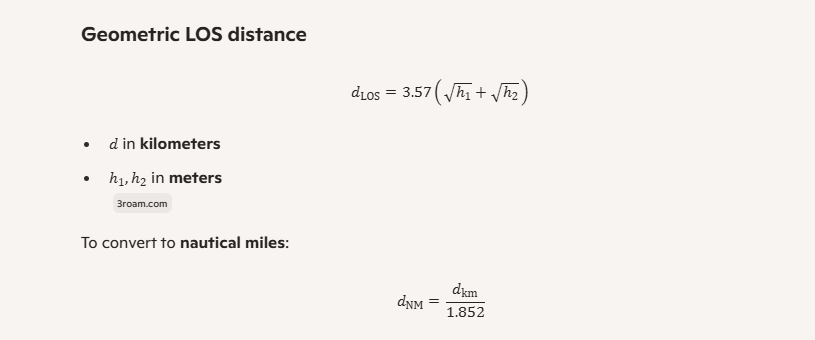
For an antenna height in meters, the distance to the horizon in kilometers is:
This formula assumes no atmospheric bending.
Radio Horizon with Standard Refraction
Atmospheric refraction extends the horizon slightly. Engineers use the “4/3 Earth radius” model:

This provides a more realistic estimate for VHF communication.
Combined Range Between Two Stations
When two antennas communicate, their LOS distances add:

For example:
- A ship antenna at 20 m height
- A coastal station antenna at 50 m height
Total range:

Limitations in Mountainous Terrain
Even with correct formulas, terrain can severely limit VHF coverage:
- Fresnel zone obstruction reduces signal strength.
- Shadow zones occur behind mountains and ridges.
- Multipath fading results from reflections off rock faces.
- Valley inversions can enhance or degrade propagation unpredictably.
Engineering Considerations
Coverage planning incorporates:
- Digital elevation models (DEMs)
- Fresnel zone clearance analysis
- Seasonal atmospheric variability
- Fade margins for reliability
- Minimum signal-to-noise thresholds
LOS formulas provide the theoretical maximum range, but real-world performance depends heavily on terrain, antenna placement, and environmental conditions.
ANTENNA TECHNOLOGIES FOR VHF
VHF antennas come in many forms, each optimized for specific applications. Because VHF wavelengths range from 1 to 10 meters, antennas are compact enough to fit on handheld devices, vehicles, ships, and aircraft.
Whip Antennas
Common on marine vessels and land‑mobile radios, whip antennas are simple, durable, and omnidirectional. Their height improves the line of‑sight, especially at sea.
Rubber‑Ducky Antennas
Used on handheld radios, these compact antennas trade efficiency for portability. Their shortened design reduces performance but remains adequate for short-range communication.
Yagi Antennas
Directional antennas are used in amateur radio, broadcasting, and point-to-point links. Yagis offer high gain and excellent interference rejection.
Log‑Periodic Antennas
Broadband directional antennas are used for measurement, monitoring, and wide‑frequency applications. They maintain consistent gain across the VHF band.
Helical and Turnstile Antennas
Used in satellite communication and specialized applications requiring circular polarization.
Collinear Arrays
Stacked vertical elements that provide high gain and omnidirectional coverage. Common in land‑mobile base stations and repeater sites.
A key engineering milestone is that VHF is the first band where antennas become small enough to mount on vehicles and handheld devices, enabling widespread adoption across industries.
VHF IN AVIATION
VHF is the backbone of global aviation communication. The 118–137 MHz band is internationally reserved for air traffic control (ATC) and air-to-air communication.
Primary ATC Communication
Pilots and controllers use AM voice communication for:
- Clearances
- Position reports
- Traffic advisories
- Weather updates
- Emergency communication
AM is used because overlapping transmissions remain partially audible, preserving situational awareness.
Pilot‑to‑Pilot Communication
Aircraft use designated VHF channels for:
- Formation flying
- Coordination in uncontrolled airspace
- Air-to-air situational awareness
Emergency Frequency 121.5 MHz
The international distress frequency is continuously monitored by:
- ATC facilities
- Many aircraft
- Search‑and‑rescue organizations
Military aircraft also monitor 243.0 MHz, the UHF harmonic of 121.5 MHz.
VHF Digital Link (VDL)
VDL supports:
- ACARS messaging
- Controller–Pilot Data Link Communications (CPDLC)
- Airline operational control
Digital VHF reduces congestion and improves efficiency.
Advantages of VHF in Aviation
- High clarity
- Predictable propagation
- Low interference
- Global standardization
Challenges
- Congestion in busy airspace
- Limited spectrum
- Dependence on line‑of‑sight coverage
A widely cited principle in aviation states that VHF remains the critical platform for clear and effective communication in global air traffic management.
VHF IN MARINE COMMUNICATION
Marine VHF, operating in the 156–162 MHz range, is the foundation of maritime safety and coordination. Its standardized channels support distress communication, ship-to-ship operations, port management, and digital alerting.
Channel 16 (156.800 MHz)
The international distress, urgency, and safety channel is used for:
- Mayday calls
- Pan‑Pan calls
- Safety broadcasts
- Initial hailing before switching to a working channel
Simplex and Duplex Channels
- Simplex: Same frequency for transmit and receive; ensures all vessels hear both sides of a conversation.
- Duplex: Separate transmit/receive frequencies; used for ship-to-shore services.
Digital Selective Calling (DSC) — Channel 70
DSC provides:
- Automated distress alerts
- Vessel identity and position
- Routine calling without voice traffic
Channel 70 is reserved exclusively for digital signaling.
Navigational Communication — Channel 13
Preventing collisions and protecting waterways:
- Ship-to-ship communication
- Ship-to-shore communication
- Bridge-to-bridge communication
ROC(M) Licensing
Operators of DSC‑equipped radios typically require the Restricted Operator Certificate (Maritime), covering:
- Channel usage
- Distress procedures
- Equipment operation
- Legal responsibilities
Distress Procedures
Standardized formats ensure clarity:
- Mayday: Immediate danger
- Pan‑Pan: Urgent but not life-threatening
These procedures are reinforced by mandatory watchkeeping requirements.
100% Free Federal. $14.99 State. Direct IRS E-File. FreeTaxUSA.com
VHF IN BROADCASTING
VHF has played a central role in global broadcasting for nearly a century. Its combination of moderate wavelength, low noise, and stable propagation makes it ideal for high-quality audio and television transmission.
FM Radio (87.5–108 MHz)
The FM broadcast band is one of the most widely used VHF allocations worldwide. FM radio benefits from:
- High audio fidelity
- Strong resistance to static
- Efficient use of bandwidth
- Reliable reception in urban and rural areas
FM’s frequency modulation technique provides superior noise rejection compared to AM, making it the standard for music and high-quality audio programming.
VHF Television Bands
Historically, analog television used two major VHF blocks:
- Band I (varies by region, often 47–68 MHz)
- Band III (typically 162–230 MHz depending on country)
These bands supported early analog TV systems such as NTSC, PAL, and SECAM.
Digital Transition
The global shift to digital broadcasting reshaped VHF usage:
- Many countries vacated VHF Band I due to noise susceptibility.
- Band III became valuable for digital multiplexes in Europe and parts of Asia.
- North America moved most digital TV stations to UHF for improved bandwidth and reception.
Regional Differences
Broadcasting plans vary significantly:
- Australia & New Zealand: Historically used VHF for analog TV; digital refarming shifted many services to UHF.
- United Kingdom: Early BBC broadcasts used Band I; digital services now primarily use UHF.
- United States & Canada: NTSC Channels 2–13 occupied 54–216 MHz; many digital stations migrated to UHF.
The Channel 6 Audio Phenomenon
In the United States, analog Channel 6 placed its audio carrier at 87.75 MHz, just below the FM band. Some low-power TV stations operated as hybrid FM broadcasters—informally known as “Franken FMs”—until digital transition rules phased out most of these operations.
VHF broadcasting continues to evolve, but its legacy remains foundational to modern media infrastructure.
VHF IN AMATEUR (HAM) RADIO
Amateur radio operators rely heavily on VHF for local and regional communication. The band’s predictable behavior, low noise, and compatibility with compact antennas make it ideal for both routine and emergency use.
Core VHF Amateur Bands
- 6 meters (50–54 MHz): Known as “the magic band” for its unpredictable long-distance openings.
- 2 meters (144–148 MHz): The most active VHF amateur band, supporting repeaters, simplex FM, digital modes, and satellites.
- 1.25 meters (222–225 MHz): Less common but valued for its quiet spectrum and strong repeater coverage in certain regions.
Typical Use Cases
- Local repeaters: Extend handheld and mobile radio range across cities and counties.
- Emergency communication: VHF FM and digital modes support ARES/RACES operations during disasters.
- Simplex operation: Direct station-to-station communication for local coordination.
- Digital modes: APRS, packet radio, and other narrowband systems use VHF for reliable data transmission.
Comparison with HF and UHF
Amateur operators often summarize the differences:
- HF: Long-distance communication via ionospheric reflection.
- VHF: Local and regional coverage with excellent clarity.
- UHF: Short-range communication with strong building penetration.
A common teaching point is that HF reaches continents, VHF reaches cities, and UHF reaches buildings—a simplified but useful mental model.
VHF remains central to amateur radio because it balances accessibility, performance, and versatility.
VHF IN DEFENSE, SPACE, AND INDUSTRY
VHF supports a wide range of specialized applications beyond aviation, maritime, and broadcasting. Its propagation characteristics make it valuable for defense, scientific research, and industrial operations.
Defense Communication
Military organizations use VHF for:
- Tactical voice communication
- Field radios
- Vehicle-mounted systems
- Secure digital links
VHF’s moderate range and resistance to noise make it ideal for coordinated operations in open terrain.
Space Research
The 137–138 MHz range is widely used for:
- Satellite downlinks
- Weather satellite imagery
- Environmental data transmission
These frequencies support global monitoring systems and scientific missions.
Industrial Applications
Industries operating in open environments rely on VHF for:
- Mining operations
- Surveying and geospatial data collection
- Autonomous agricultural systems
- Remote‑controlled industrial vehicles
- Subsea and offshore communication
VHF’s ability to cover large areas with minimal infrastructure makes it cost‑effective and reliable for field operations.
Across defense, space, and industry, VHF remains a trusted tool for mission‑critical communication.
GLOBAL FREQUENCY ALLOCATION BY REGION
Although VHF is standardized internationally, each region structures its frequency allocations based on historical usage, regulatory frameworks, and national priorities.
Australia
- Historically used VHF Bands I and III are used for analog TV.
- Digital transition moved many services to UHF.
- FM radio uses 87.5–108 MHz.
New Zealand
- Similar to Australia, with VHF TV phased out in favor of UHF digital services.
- Marine and aviation allocations follow ITU standards.
United Kingdom
- Early BBC television used VHF Band I.
- ITV used Band III.
- Digital switchover moved nearly all services to UHF.
- FM radio remains in the 88–108 MHz band.
United States & Canada
- NTSC Channels 2–13 occupied 54–216 MHz.
- Many digital stations relocated to UHF for improved bandwidth.
- Marine, aviation, and amateur allocations follow ITU Region 2 standards.
Why These Differences Matter
Regional allocation differences affect:
- Channel numbering
- Broadcast planning
- Equipment compatibility
- Cross‑border coordination
Despite these variations, VHF remains globally harmonized for aviation, maritime, and amateur radio.
VHF VS UHF VS HF
Understanding the differences between HF, VHF, and UHF helps operators choose the right band for their needs.
Frequency Ranges
- HF: 3–30 MHz
- VHF: 30–300 MHz
- UHF: 300 MHz–3 GHz
Propagation Differences
- HF: Long‑distance skywave propagation; sensitive to solar conditions.
- VHF: Line‑of‑sight; stable and low‑noise.
- UHF: Short‑range; strong indoor penetration.
Penetration vs Distance
- Lower frequencies travel farther but penetrate poorly.
- Higher frequencies penetrate buildings but they have shorter outdoor range.
Use‑Case Suitability
- HF: Global communication, maritime beyond line‑of‑sight, amateur DXing.
- VHF: Aviation, maritime, land‑mobile, emergency services.
- UHF: Urban communication, handheld radios, Wi‑Fi, GPS.
Industry Recommendations
A widely accepted principle is that lower‑frequency radios with longer wavelengths perform best in wide, open areas, while higher frequencies excel in dense urban environments.
VHF occupies the middle ground, offering a balance of range, clarity, and reliability unmatched by other bands.
VHF EQUIPMENT TYPES
VHF communication systems rely on a range of equipment types designed for different operational environments. The choice of equipment affects range, clarity, reliability, and regulatory compliance.
Handheld VHF Radios
Portable VHF radios are widely used in:
- Marine operations (dinghies, kayaks, small craft)
- Aviation ground crews
- Emergency services
- Amateur radio
Handheld units typically transmit at 1–6 W and use compact antennas. Their range is limited but sufficient for short-distance communication, especially when repeaters or elevated receiving stations are available.
Fixed‑Mount VHF Radios
Fixed radios offer:
- Higher power output (20–25 W)
- Larger, more efficient antennas
- Better audio quality
- Greater reliability in harsh environments
These units are standard on ships, aircraft, and land‑mobile installations where consistent communication is essential.
Antenna Considerations
Antenna performance often matters more than transmitter power. Key factors include:
- Height: The most important determinant of range.
- Gain: Higher-gain antennas focus energy more effectively.
- Placement: Avoiding obstructions improves signal quality.
- Ground plane: Essential for many vertical antennas.
Power Output and Range
While increasing power can extend range, the benefits diminish quickly due to line-of-sight limitations. A well-placed antenna often outperforms a high-power transmitter with poor placement.
Best Practices
Many operators use both handheld and fixed radios:
- Fixed radios for primary communication
- Handheld radios for redundancy and mobility
This combination ensures resilience in the event of equipment failure or power loss.
EMERGENCY AND SAFETY PROTOCOLS
VHF plays a central role in global safety systems. Its predictable propagation and international standardization make it the preferred band for distress communication in both aviation and maritime environments.
Distress Procedures
Two standardized distress formats ensure clarity:
- Mayday: Used when life or a vessel is in immediate danger.
- Pan‑Pan: Used for urgent situations that are not immediately life-threatening.
These calls follow a strict structure that includes vessel identification, position, nature of distress, and assistance required.
Why Cell Phones Cannot Replace VHF
Cellular networks are not suitable for maritime or aviation emergencies because:
- They do not broadcast to all nearby vessels or aircraft.
- Coverage is limited offshore and at altitude.
- Networks may fail during disasters.
- They cannot integrate with DSC or ATC systems.
VHF remains the only universally monitored, interoperable emergency communication method.
Digital Selective Calling (DSC)
DSC automates distress signaling by transmitting:
- Vessel identity
- GPS position
- Distress category
Channel 70 is reserved exclusively for DSC to prevent interference.
Watchkeeping Requirements
Many maritime authorities require continuous monitoring of:
- Channel 16 (voice distress)
- Channel 70 (DSC distress)
These requirements ensure a rapid response to emergencies.
COMPLEMENTARY AND COMPETING TECHNOLOGIES
VHF coexists with a wide range of communication technologies. Each has strengths and limitations, and industries often use multiple systems to achieve full coverage and redundancy.
Complementary Technologies
- VOR/ILS: Aviation navigation systems that integrate with VHF communication.
- Two-way radio networks: Used in public safety and industrial operations.
- HF radio: Provides long-distance communication beyond line‑of‑sight.
- Satellite communication: Offers global coverage where VHF cannot reach.
Competing Technologies
- UHF: Better building penetration and dense channel allocation.
- LMR (Land Mobile Radio): Digital trunked systems for public safety.
- MotoTRBO / DMR: Digital VHF/UHF systems with enhanced features.
- 800/900 MHz trunked networks: Widely used in urban environments.
- Wireless broadband: Supports high‑bandwidth applications but lacks VHF’s reliability.
Industry Adoption
Different industries choose technologies based on:
- Terrain
- Coverage requirements
- Regulatory constraints
- Equipment cost
- Interoperability needs
VHF remains essential because it offers a balance of simplicity, reliability, and global standardization.
MODERN CHALLENGES AND FUTURE TRENDS
VHF continues to evolve as new technologies emerge and spectrum demands increase. Several trends are shaping the future of VHF communication.
Spectrum Congestion
Growing demand from aviation, maritime, and land‑mobile services has increased pressure on VHF allocations. Channel spacing reductions (e.g., 8.33 kHz in aviation) were introduced to expand capacity.
Digital Modulation
Digital systems such as VDL and DMR are improving:
- Channel efficiency
- Data throughput
- Error correction
- Interference resistance
These technologies extend VHF’s usefulness in modern communication networks.
Satellite‑Based VHF
New satellite systems are exploring VHF uplinks and downlinks to provide:
- Global coverage
- Redundancy for remote regions
- Enhanced safety services
This hybrid approach may redefine long‑range VHF communication.
Migration of TV Services
Many countries continue to relocate television broadcasting from VHF to UHF, freeing spectrum for other services.
Autonomous Systems
VHF is increasingly used in:
- Autonomous agricultural machinery
- Industrial robotics
- Remote‑controlled mining equipment
- Unmanned maritime systems
These applications require reliable, medium‑range communication that VHF provides.
VHF remains one of the most important and versatile communication bands in the world. Its combination of clarity, reliability, moderate range, and global standardization makes it indispensable across aviation, maritime, defense, broadcasting, emergency services, and industrial operations.
Why VHF Remains Essential
- Predictable line‑of‑sight propagation
- Low atmospheric noise
- Internationally harmonized allocations
- Compatibility with simple, robust antennas
- Strong performance in open terrain and over water
- Integration with navigation and safety systems
Cross‑Industry Relevance
VHF supports:
- Air‑traffic control
- Marine distress communication
- FM broadcasting
- Amateur radio
- Industrial telemetry
- Defense operations
- Space research
Very High Frequency (VHF) is the 30–300 MHz portion of the electromagnetic spectrum used for aviation communications, marine safety, FM broadcasting, land mobile radio, and navigation systems such as VOR and ILS. VHF provides clear, reliable, line-of-sight communication with low interference, making it essential for global transportation, emergency response, and industrial operations. Its standardized frequency allocations, efficient propagation, and compatibility with compact antennas ensure that VHF remains a foundational technology in modern communication networks.
It is an electromagnetic wave generated by the radio transmitter within the range of the radio frequency spectrum of 30–300 MHz. VHF coverage with low-interference communication and long-range radio signals; therefore, VHF reliability makes it ideal for open‑water and open‑terrain environments. VHF propagation characteristics are widely used to support long-distance line-of-sight communication in the marine and aviation industries because they provide clear and stable voice transmission and less signal attenuation than UHF.
VHF applications are widely used worldwide because VHF equipment is relatively inexpensive and readily available. It is also standardized and regulated across countries. A VHF antenna is compatible with simple, low-cost antennas. It supports both analog and digital modulation. Common frequency modulation techniques are used worldwide for FM radio broadcasting. Because of its reliability for emergency and rescue communication, and efficiency for point-to-point and broadcast systems, it is often used in public safety and disaster response. VHF performs well on mobile and handheld radios.
100% Free Federal. $14.99 State. Direct IRS E-File. FreeTaxUSA.com